Jaap Mooy (1915-1987) chose the language of art to depict “the insane, evil chaos of society.” He expressed his discontent raw and direct—but not without humor—in countless collages, drawings, and (scrap) sculptures. Like a sailor, he charted his own course in life and work. Guest curator Cees de Boer used Mooy’s engagement as a guiding principle for an exhibition at Museum Kranenburgh, designed by graphic designer Jan van Toorn.

North-West South-East
Jaap Mooy
Bergen artist Jaap Mooy (1915-1987), trained as a blacksmith and metalworker, encountered visual art through Charley Toorop in the late 1930s. Toorop advised him not to pursue artistic training, but rather to remain self-taught. With his Cobra-esque, sometimes surrealist, or more naively expressive art, Mooy defies stylistic categorization. He is a loner, but above all a committed individual. The experiences he gained during the Second World War are expressed in his many collages, drawings, and (scrap metal) sculptures. In them, he takes a stand against those in power, against systems and dependency, and champions the cause of the victims.
Mooy Scrap Metal
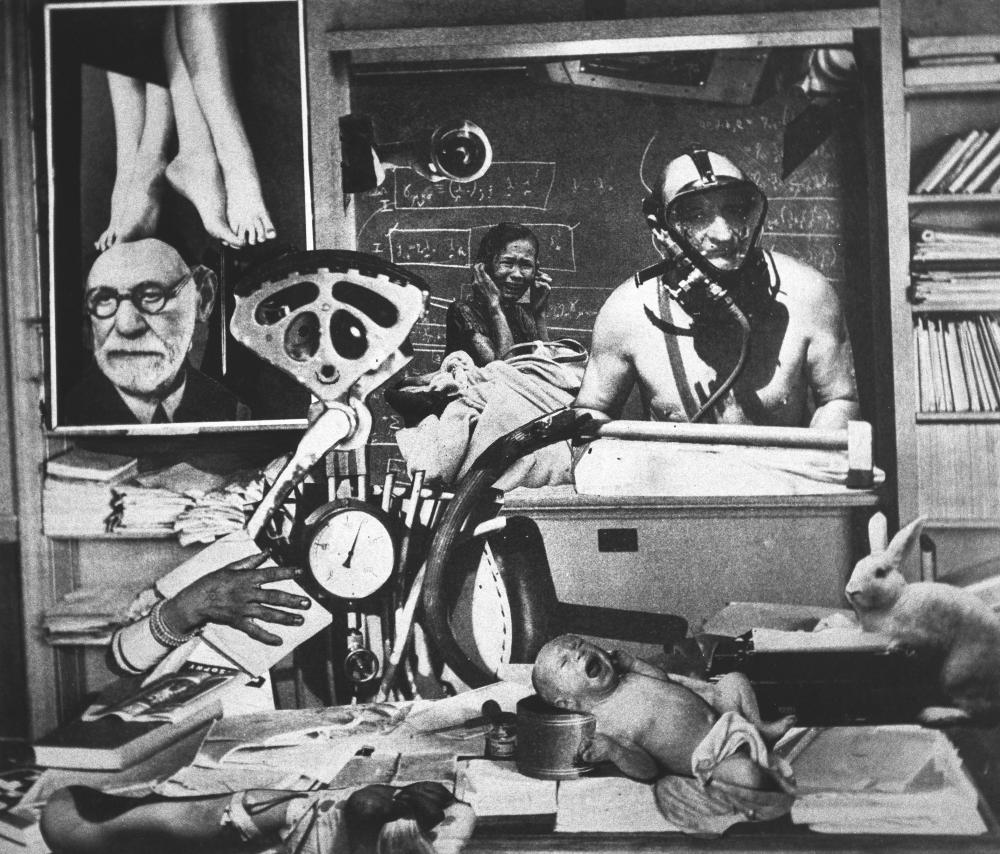
Bergen artist Jaap Mooy, trained as a blacksmith and metalworker, encountered visual art through Charley Toorop in the late 1930s. Toorop advised him not to pursue artistic training, but rather to remain self-taught. With his Cobra-esque, sometimes surreal, or more naively expressive art, Mooy defies stylistic categorization. His early work shows an affinity with Cobra, but loner Mooy refuses to become a member of this movement. He did, however, participate in the 1964 Venice Biennale with Karel Appel and Lucebert. Mooy also expresses his ideas about the world in so-called viewing cabinets: montages of all kinds of materials, found objects, and texts, which sometimes read like a personal diary, sometimes like “messages from society.” In his work on paper, he creates a chaotic, oppressive world. He builds sculptures from scrap metal, often based on the human figure. Time and again, children, people, animals, and angels attempt to “elevate” themselves: as warriors, generals, or dictators, as children, girls, or women, as animals, birds, or Icarus. His later sculptures share similarities with absurdism, in which the madness of everyday life is a recurring motif.
Art Against Madness
Fostered by his experiences during World War II, Mooy speaks out in his work against those in power, against systems and dependency, and champions the victims. The exhibition reveals how deeply Mooy was gripped by political and social events from the 1950s to the 1980s. His art responds directly and forcefully to situations in which crimes against humanity are committed, such as during the Hungarian Uprising in 1956. He portrays political figures, as well as religious leaders, as perpetrators.
The Unspoiled World
A counterbalance is provided by the work from Mooy’s final years, in which he once again draws inspiration from the world of children. He incorporates drawings and stories of children into his work and often draws together with his neighbor Jessica. This results in a series of works in which Mooy depicts the world he longs for: an unspoiled world, before upbringing, education, religion, and society, in his view, force us into a straitjacket.
Jacques and Miny Defauwes
Collectors Jacques and Miny Defauwes Jacques and Miny Defauwes have been collecting art for almost half a century, and the work of Jaap Mooy occupies a prominent place in their collection. Kranenburgh has loaned a large number of Mooy’s works for this exhibition.
Publication
The book Jaap Mooy. North-West South-East. The Artist and His Collector. The Defauwes Collection, with texts by Emile Hollman, Catharien Romijn, Cees de Boer, Hans den Hartog Jager, Stijn Huijts, and Mariette Dölle (Amsterdam: Schilt Publishing, 2017), is available for purchase in the museum shop during the exhibition. The book was initiated and financed by Jacques and Miny Defauwes, and is uniquely designed by Kummer & Herrman. It is also available in English.
Listen to the podcast
Want to know more about the exhibition and Jaap Mooy? Caspar Stalenhoef created a podcast featuring stories from curator Cees de Boer and Jacques Defauwes, a collector and friend.

Jaap Mooy. Noord-West Zuid-Oost (met Cees de Boer en Jan van Toorn)
Jaap Mooy (1915-1987) was een ‘outsider artist’ die…
Artworks
Jaap Mooy
Lucebert
1954

Jaap Mooy
Z.t. (Great White Father)
1955
Jaap Mooy
Het Oordeel
1955

Jaap Mooy
Generalissimus
1958


