Actor and visual artist Jeroen Krabbé spent almost every weekend in the artists’ village during his youth. He lived in Bergen for a while and met his current wife there, but also experienced a sad period there, a phase in which he felt alone and isolated. The exhibition’s title refers to the Latin motto of Krabbé’s birth announcement: “Let us live while we live.” Loosely translated: Make something of life and enjoy it! The exhibition features a series of paintings Krabbé created based on his childhood drawings.

Dum vivimus vivamus
Images from my youth in Bergen
Autobiography
The exhibition reads like a visual autobiography. “When I created the series of paintings a few years ago, all the memories came flooding back: the smells, the images; the deserted beach and the many bunkers. Bergen was a very special, quiet village.” All the children’s drawings in Kranenburgh date from the period 1947–1958. They partly refer to Bergen. This is also true, for example, of the work featuring his wife Herma, brother Tim, and a calf, which harks back to a photograph in Bergen from 1954. The exhibition was created in collaboration with Museum De Fundatie.
In Love
In the late 1940s, his grandmother had the house d’Vogelsangh built on Rondelaan in Bergen, right behind Kranenburgh, and the family stayed there almost every weekend. Sometimes they went to Pension Bloemhof on Zuidlaan, where one day Jeroen passed a family on the stairs who, like the Krabbés, came from Amsterdam. He remembers his mother’s reaction after they arrived in the room. “What’s wrong? You look so strange.” Jeroen Krabbé (1944) was nine and knew what to say. “I’m in love with that girl.” More than sixty years later, they are still together.
Isolated
Not long after, he lived in Bergen for a long time due to his parents’ divorce. “My aunt taught me in the mornings. Afterward, I walked through Bergen all alone. I knew every stone and every tree.” Like every other child, he “hated” his school in Amsterdam. In Bergen, he heard the children clapping their desks through an open classroom. “I wanted that too.” He was alone and experienced an isolated period that seemed to last forever and stood in stark contrast to the happy years before.
Whip
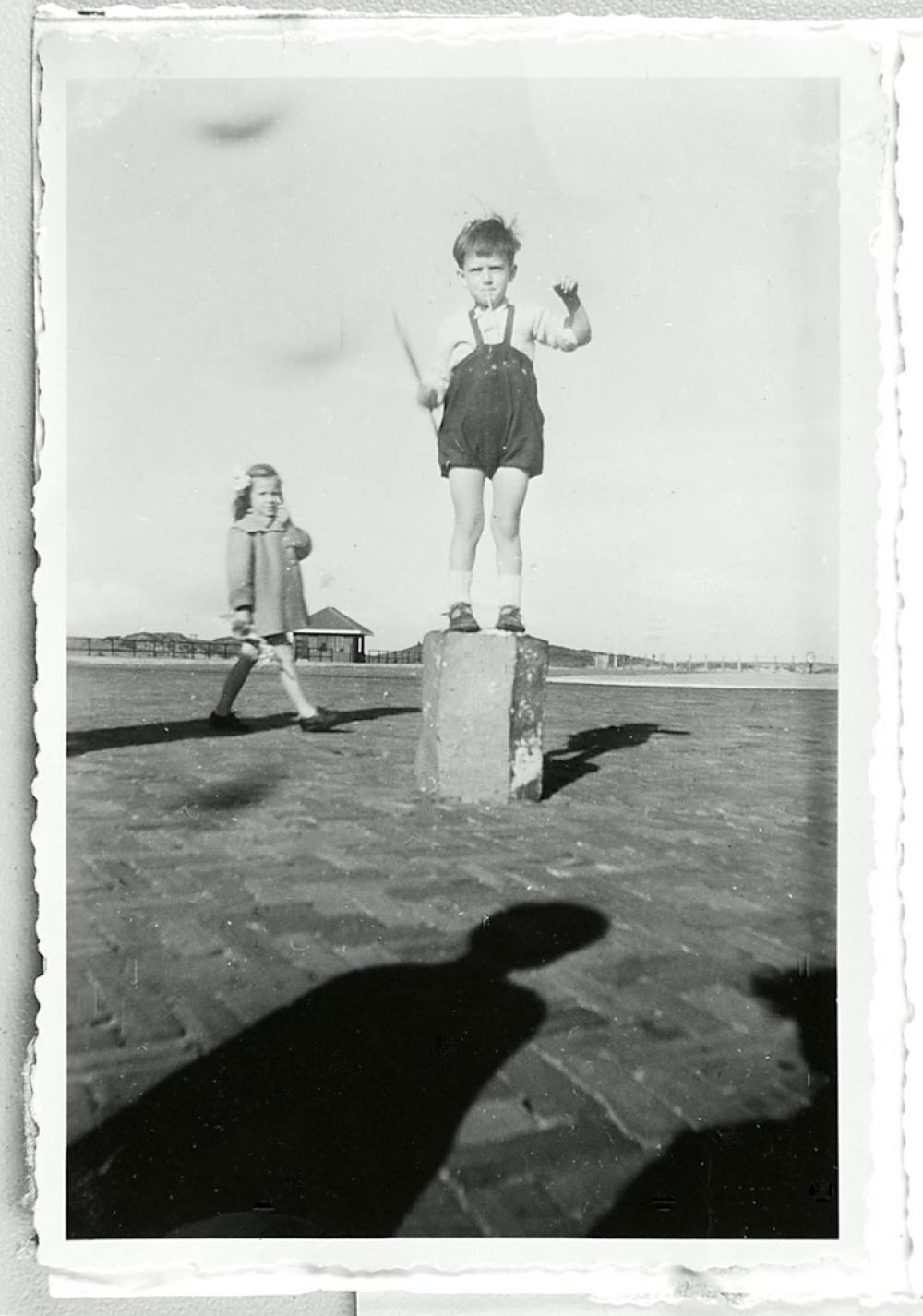
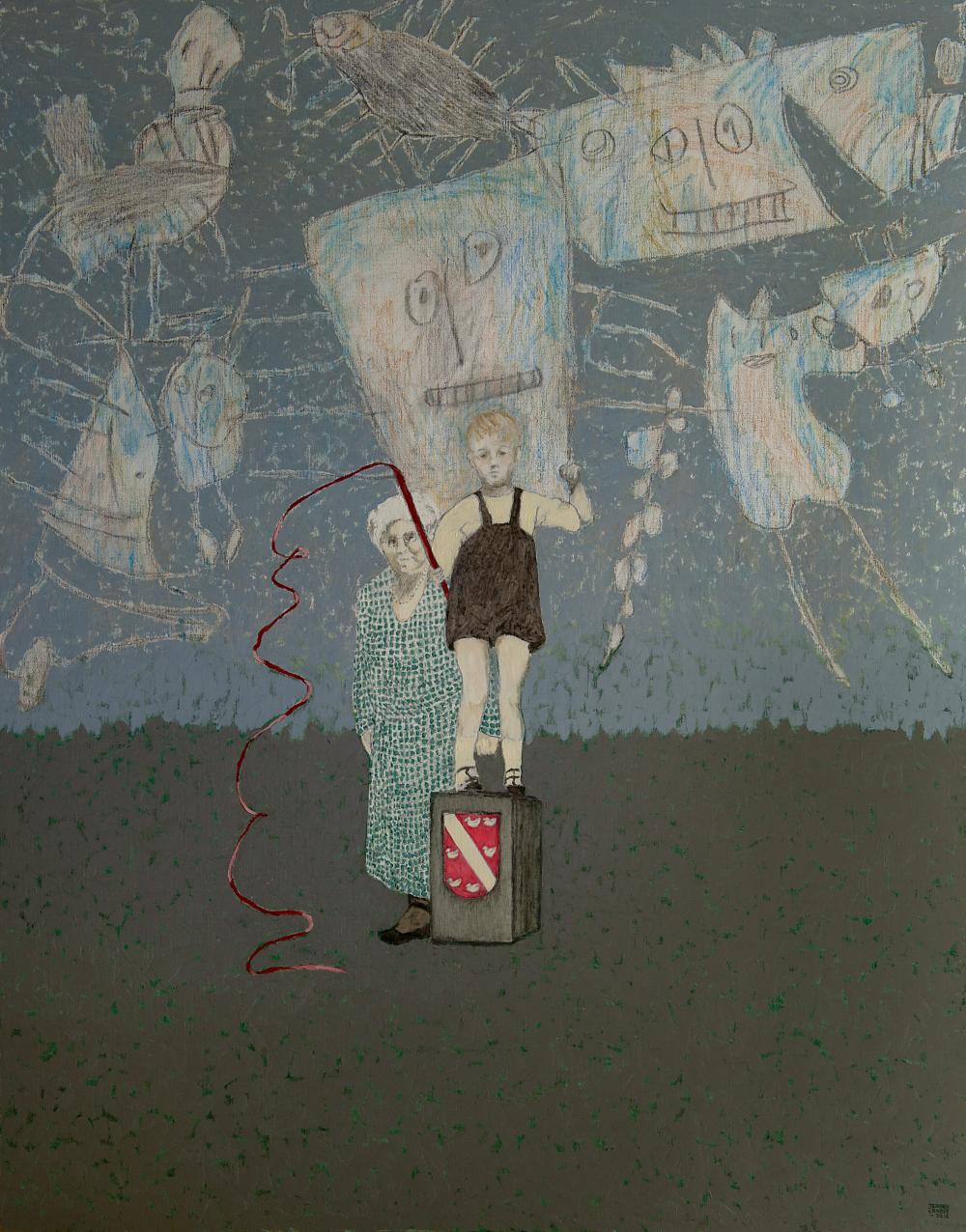
One of the works in the exhibition recalls that time. Krabbé was inspired by a photo from the family album, in which he is depicted perched on a concrete post in Bergen aan Zee. On the pedestal, he painted the old coat of arms of Bergen. In the 2011/2012 version, he has himself appear next to his grandmother. “I have a whip in my hand, like a circus director, trying to keep the animals (and perhaps my grandmother as well) under control.” He incorporated his drawing Stekelman no. 2 from 1948 into the background.